

Table of Contents
Bingo Star pattern chart: cells and multipliers
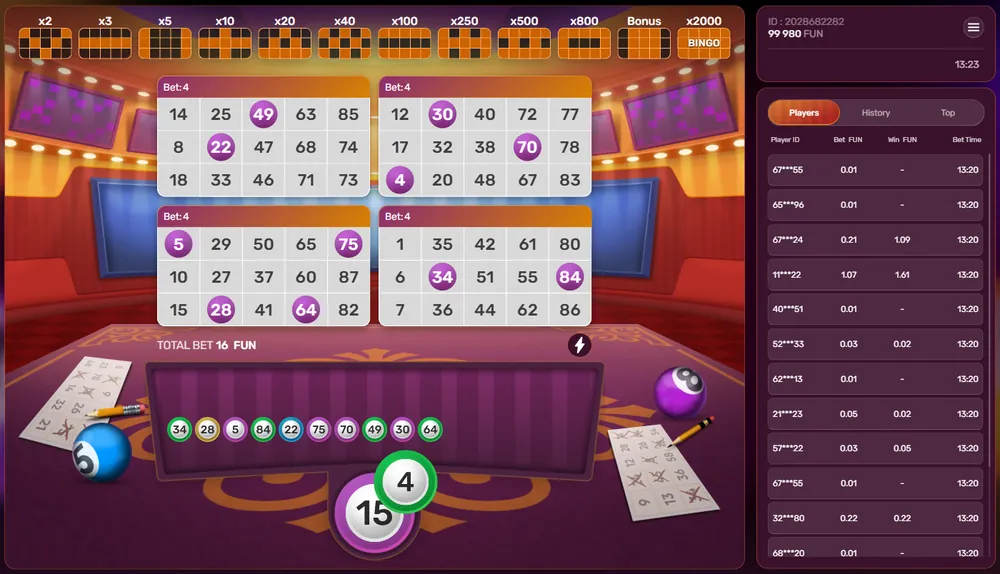
The smallest Bingo Star pattern needs five numbers and pays x2; the full card needs fifteen and pays x2000. The strip above the tickets shows the same shapes during the round: a collected cell turns green, and the shape that is one number short is marked in yellow.
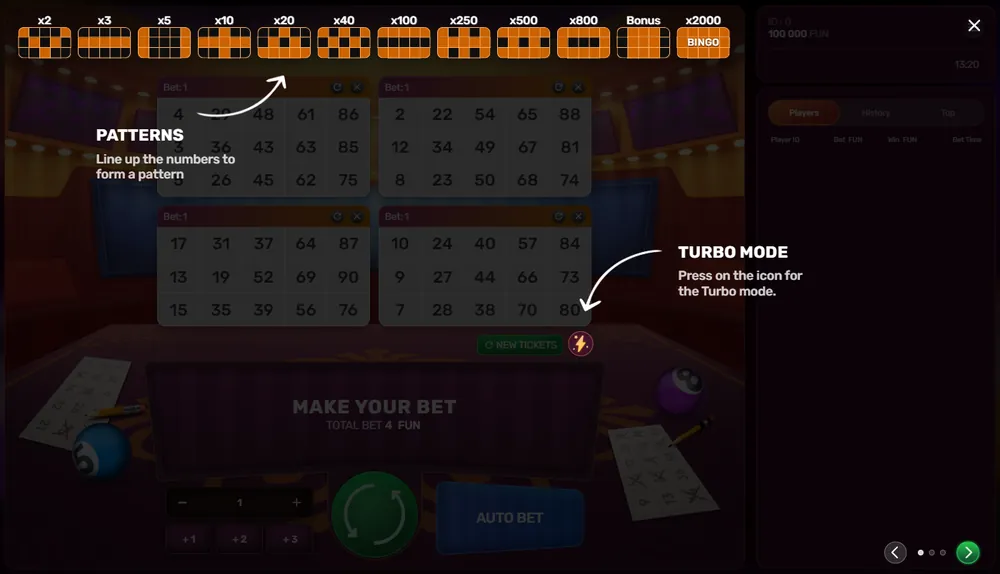
| Pattern | Cells | Pays |
|---|---|---|
| V shape from two top corners to the middle of the bottom row | 5 | x2 |
| One full horizontal line | 5 | x3 |
| Both outer columns | 6 | x5 |
| Cross: middle row plus middle column | 7 | x10 |
| Pyramid with a full bottom row | 8 | x20 |
| Checkerboard | 8 | x40 |
| Top and bottom rows | 10 | x100 |
| Middle row plus three full columns | 11 | x250 |
| Top and bottom rows with two cells between them | 12 | x500 |
| Frame around the ticket | 12 | x800 |
| Three middle columns | 9 | Bonus round |
| Full ticket, Bingo | 15 | x2000 |
Two shapes with the same number of cells pay different money because the game rates their position, not only their size. The pyramid and the checkerboard both take eight numbers, yet the first returns twenty stakes and the second returns forty. The frame beats the shape with two inner cells in the same way: 800 stakes against 500.
How a ticket is laid out
Each ticket has fifteen numbers in three rows and five columns, and each column covers eighteen values: 1–18, 19–36, 37–54, 55–72 and 73–90. No number repeats inside a ticket. A practice ticket with virtual balls lets you see every column fill up before you stake money. Before the bet you can replace a single ticket with the round arrow in its header, remove it with the cross, or refresh all of them with New Tickets.
Small patterns from x2 to x10
Four shapes make up the everyday wins: V, line, outer columns and cross. With a stake of 4 FUN a single line pays 12 FUN, which is the result shown in the demo round on this site: numbers 4, 20, 48, 67 and 83 closed the bottom row and the ticket header turned green. Such a win does not cover four tickets at the same stake, because the round costs 16 FUN. That is why the small end of the table keeps the balance moving rather than growing. The RTP range and payout conditions explain the average return behind these numbers.
Star bingo pattern and the Bingo Star card
A star bingo pattern in hall bingo is a star drawn on a 5 by 5 card. The Galaxsys game has no such shape: its ticket is 3 by 5, and the closest figure is the checkerboard that pays x40. A search for a star pattern therefore often leads to printable cards for another game, with other rules and no multipliers.
Large patterns: x100 and above
Five shapes pay x100 or more, and each of them needs at least ten numbers out of fifteen. The gap between them is wide, so one missing cell changes the result sharply: the frame pays 800 stakes, and the ticket with every cell closed pays 2000. The Extra Ball offer appears in exactly this situation, when one to three numbers separate the ticket from a better shape.
Bonus pattern
The Bonus pattern closes the three middle columns, nine cells in total, and opens a mini-game instead of a fixed payout. The player opens hidden cells and receives a multiplier from x30 to x1000. The shape is worth more than its size suggests: nine numbers open a prize that only the full card can pass.
Silver and gold balls
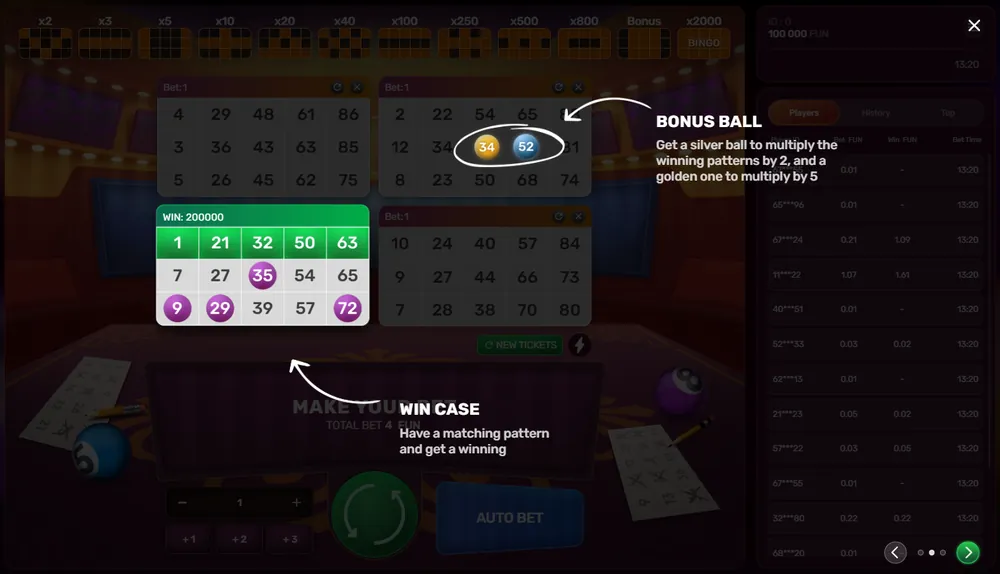
A silver ball multiplies the winning pattern by 2, and a gold ball multiplies it by 5. The tutorial of the game shows both balls on its second screen. A gold ball with a cross turns x10 into x50; the same ball with a line turns x3 into x15.
Extra balls and the last missing number
After 30 balls the green button changes to Extra and shows the price of one more ball. Up to 14 extra balls are sold in a round, each with its own price, and End Game closes the round without a purchase. In the demo round shown on this site the first extra ball cost 2.41 FUN with a base bet of 16 FUN, and the total bet rose to 18.41 FUN. Compare the price with the payout of the marked shape before each purchase, because the remaining pool still holds around sixty numbers; a session plan with a purchase limit keeps this cost under control.
Auto Bet has a separate Buy Extra Ball switch. With the switch off, the series plays only the base draw of 30 balls, and the Loss Limit field stops it at the chosen amount.
Questions about Bingo Star patterns
How many patterns are there in Bingo Star?
The game has twelve patterns: eleven with a multiplier from x2 to x2000 and one that opens the bonus round.
Which pattern pays the most?
The full ticket of fifteen numbers pays x2000. The frame of twelve cells is next and pays x800.
How many tickets can I play at once?
From one to four. Every ticket carries the same stake, so four tickets at 4 FUN cost 16 FUN per round.
Do all four tickets use the same patterns?
Yes. The table is the same for every ticket, and each of them is paid separately according to its own stake.
What does a yellow cell in the pattern strip mean?
The yellow cell marks the number that is missing for the shape. A matching cell on the ticket is highlighted in orange.
Is there a star-shaped pattern?
No. The 3 by 5 ticket has no star shape; the checkerboard at x40 is the closest figure.